Antilochus
Mortal man
In Greek mythology, Antilochus (; Ancient Greek: Ἀντίλοχος Antílokhos) was a prince of Pylos and one of the Achaeans in the Trojan War. He was the youngest prince to command troops.
Explore on the graph- Mentions
- 34
- Connected characters
- 10
- Books
- 10


Mentions in the Iliad
A. T. Murray, Loeb Classical Library, Harvard University Press, 1924 · Homer, Iliad with an English Translation · CC BY-SA 3.0 US
“and far off amid the mountains the shepherd heareth the thunder thereof; even so from the joining of these in battle came shouting and toil. Antilochus was first to slay a warrior of the Trojans in full armour, a goodly man amid the foremost fighters, Echepolus, son of Thalysius. Him was he first to smite upon the horn of his helmet with crest of horse-hair,”
“But Antilochus, son of great-souled Nestor, beheld him, and strode through the foremost fighters; for greatly did he fear for the shepherd of the host, lest aught befall him, and he utterly thwart them of their toil. Now the twain were holding forth their hands and their sharp spears each against the other, fain to do battle,”
“and Antilochus made a cast at Mydon, his squire and charioteer, the goodly son of Atymnius, even as he was turning the single-hooved horses, and smote him with a stone full upon the elbow; and the reins, white with ivory, fell from his hands to the ground in the dust. Then Antilochus leapt upon him and drave his sword into his temple,”
“and Odysseus with his spear of bronze laid low Pidytes of Percote, and Teucer goodly Aretaon. And Antilochus, son of Nestor, slew Ablerus with his bright spear, and the king of men, Agamemnon, slew Elatus that dwelt in steep Pedasus by the banks of fair-flowing Satnioeis.”
“lightly passing among them, aroused their strong battalions. To Teucer first he came and to Leïtus, to bid them on, and to the warrior Peneleos, and Thoas and Deïpyrus, and Meriones and Antilochus, masters of the war-cry; to these he spake, spurring them on with winged words:”
“neither dared turn the horses back and so escape from out the hands of the foemen; but Antilochus, staunch in fight, aimed at him, and pierced him through the middle with his spear, nor did the corselet of bronze that he wore avail him, but he fixed the spear full in his belly. And gasping he fell from out his well-built car,”
“even as he fareth to the house of Hades, the strong warder, will he be glad at heart, for lo, I have given him one to escort him on his way! So spake he, and upon the Argives came sorrow by reason of his exulting, and beyond all did he stir the soul of wise-hearted Antilochus; howbeit, despite his sorrow, he was not unmindful of his dear comrade,”
See all 33
Connections
Father · Sources
But Antilochus, son of great-souled Nestor, beheld him, and strode through the foremost fighters; for greatly did he fear for the shepherd of the host, lest aught befall him, and he utterly thwart them of their toil. Now the twain were holding forth their hands and their sharp spears each against the other, fain to do battle,
and Odysseus with his spear of bronze laid low Pidytes of Percote, and Teucer goodly Aretaon. And Antilochus, son of Nestor, slew Ablerus with his bright spear, and the king of men, Agamemnon, slew Elatus that dwelt in steep Pedasus by the banks of fair-flowing Satnioeis.
and the horses Antilochus, son of great-souled Nestor, drave forth from the Trojans into the host of the well-greaved Achaeans. Then Deïphobus in sore grief for Asius drew very nigh to Idomeneus, and cast at him with his bright spear. Howbeit Idomeneus, looking steadily at him, avoided the spear of bronze,
Il. 5.565 · Il. 6.32 · Il. 13.400 · Il. 13.545 · Il. 14.513 · Il. 18.16 · Il. 23.305 · Il. 23.350 · Il. 23.402 · Il. 23.541 · Il. 23.597 · Il. 23.755–756 · Il. 23.785
Brother through father · Sources
Квалификация братства/сестринства: Илиада: Общий отец подтверждён; сведения о матерях неполны. Различие матерей не установлено. Общие родители: Нестор.
Wikidata: Нестор — пол родителя · P21and standing far apart. But those in the midst suffered woes by reason of the darkness and the war, and were sore distressed with the pitiless bronze, even all they that were chieftains. Howbeit two men that were famous warriors, even Thrasymedes and Antilochus, had not yet learned that peerless Patroclus was dead, but deemed that,
Il. 17.378
Friend · Sources
So spake he , and swift-footed, goodly Achilles smiled, having joy in Antilochus, for that he was his dear comrade; and he made answer, and spake to him winged words: Antilochus, if thou wilt have men give to Eumelus some other thing from out my house as a further prize, even this will I do.
Il. 23.556
Killed by Antilochus · Sources
Описание прямо называет Атимния убитым Антилохом; 16.317–319: Антилох нападает на Атимния и пробивает его копьём, тот падает.
a man's muscle is thickest; and round about the spear-point the sinews were rent apart; and darkness enfolded his eyes. Then of the sons of Nestor, the one, Antilochus, thrust at Atymnius with his sharp spear, and drave the spear of bronze through his flank; and he fell forward. But Maris, hard at hand,
Il. 16.317–319
Killed by Antilochus · Sources
and far off amid the mountains the shepherd heareth the thunder thereof; even so from the joining of these in battle came shouting and toil. Antilochus was first to slay a warrior of the Trojans in full armour, a goodly man amid the foremost fighters, Echepolus, son of Thalysius. Him was he first to smite upon the horn of his helmet with crest of horse-hair,
Il. 4.457–458
Killed by Antilochus · Sources
В 6.32 Антилох опрокинул Албера (Аблера) пикой; событие «Антилох убивает Албера» подтверждает убийство.
and Odysseus with his spear of bronze laid low Pidytes of Percote, and Teucer goodly Aretaon. And Antilochus, son of Nestor, slew Ablerus with his bright spear, and the king of men, Agamemnon, slew Elatus that dwelt in steep Pedasus by the banks of fair-flowing Satnioeis.
Il. 6.32–33
Friend · Sources
Long time was he speechless, and both his eyes were filled with tears, and the flow of his voice was checked. Yet not even so was he neglectful of the bidding of Menelaus, but set him to run, and gave his armour to his peerless comrade Laodocus, that hard beside him was wheeling his single-hoofed horses.
Il. 17.698–699
See all 10
Charioteer · Sources
Описание называет Ноемона спутником Антилоха; стих 23.612 прямо называет его «вознице его Ноемону», то есть возницей Антилоха.
and will give unto thee the mare, for all she is mine own, to the end that these too may know that my heart is never over-haughty neither unbending. He spake, and gave the mare unto Nosmon, the comrade of Antilochus, to lead away, and himself thereafter took the shining cauldron. And Meriones took up the two talents of gold in the fourth place,
Il. 23.612–613
Killed by Antilochus · Sources
Стих 14.513 прямо говорит: «Мермера Несторов сын Антилох опрокинул».
when once the famed Shaker of Earth had turned the battle. Aias verily was first, the son of Telamon. He smote Hyrtius, the son of Gyrtius, leader of the Mysians stalwart of heart; and Antilochus stripped the spoils from Phalces and Mermerus, and Meriones slew Morys and Hippotion,
Il. 14.513
Killed by Antilochus · Sources
Стих 14.513: «Мермера Несторов сын Антилох опрокинул и Фалька».
when once the famed Shaker of Earth had turned the battle. Aias verily was first, the son of Telamon. He smote Hyrtius, the son of Gyrtius, leader of the Mysians stalwart of heart; and Antilochus stripped the spoils from Phalces and Mermerus, and Meriones slew Morys and Hippotion,
Il. 14.513
In art

Nikolai Ge. Ахиллес оплакивает Патрокла. Belarusian National Arts Museum. Public domain. https://www.wikidata.org/wiki/Q17117194
Photograph / reproduction: Nikolai Ge
Photograph / reproduction date: 1855
Nikolai Ge. Ахиллес оплакивает Патрокла. Belarusian National Arts Museum. Public domain. https://www.wikidata.org/wiki/Q17117194
Photograph / reproduction: Nikolai Ge
Photograph / reproduction date: 1855

Peter Paul Rubens. The Death of Achilles. Museum Boijmans Van Beuningen. Public domain. https://www.wikidata.org/wiki/Q19926216
Peter Paul Rubens. The Death of Achilles. Museum Boijmans Van Beuningen. Public domain. https://www.wikidata.org/wiki/Q19926216

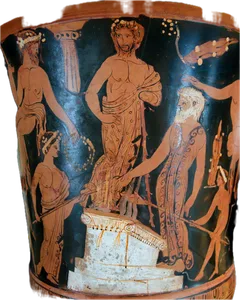
Attic red-figure neck-amphora. Department of Greek, Etruscan, and Roman Antiquities of the Louvre. Public domain. https://www.wikidata.org/wiki/Q87346683
Attic red-figure neck-amphora. Department of Greek, Etruscan, and Roman Antiquities of the Louvre. Public domain. https://www.wikidata.org/wiki/Q87346683
See all 3
Sources and verification
The character is matched to the catalogue.
- Wikipedia · Antilochus · CC BY-SA 4.0
Excerpt; remaining sentences omitted.
Reference material remains distinct from the poem’s assertions. Characters who share a name retain separate pages.