Patroclus
Mortal man
Patroclus (; Ancient Greek: Πάτροκλος, romanized: Pátroklos, lit. 'glory of the father') was a Greek hero of the Trojan War and close companion of the hero Achilles in Greek mythology. Patroclus is an important character in Homer's Iliad.
Explore on the graph- Mentions
- 129
- Connected characters
- 36
- Books
- 14


Mentions in the Iliad
A. T. Murray, Loeb Classical Library, Harvard University Press, 1924 · Homer, Iliad with an English Translation · CC BY-SA 3.0 US
“The son of Peleus went his way to his huts and his balanced ships together with the son of Menoetius, and with his men; but the son of Atreus launched a swift ship on the sea, and chose for it twenty rowers, and drove on board a hecatomb for the god, and brought the fair-cheeked daughter of Chryses and set her in the ship;”
“who sent you forth for the sake of the girl, Briseis. But come, Patroclus, sprung from Zeus, bring forth the girl, and give her to them to lead away. However, let these two themselves be witnesses before the blessed gods and mortal men, and before him, that ruthless king, if hereafter”
“and led forth from the hut the fair-cheeked Briseis, and gave her to them to lead away. So the two went back beside the ships of the Achaeans, and with them, all unwilling, went the woman. But Achilles burst into tears, and withdrew apart from his comrades, and sat down on the shore of the grey sea, looking forth over the wine-dark deep.”
“on the day when at the sterns of the ships they shall be fighting in grimmest stress about Patroclus fallen; for thus it is ordained of heaven. But of thee I reck not in thine anger, no, not though thou shouldst go to the nethermost bounds of earth and sea, where abide Iapetus and Cronos,”
“and Patroclus alone sat over against him in silence, waiting until Aeacus' son should cease from singing. But the twain came forward and goodly Odysseus led the way, and they took their stand before his face; and Achilles leapt up in amazement with the lyre in his hand, and left the seat whereon he sat;”
“and made them sit on couches and rugs of purple; and forthwith he spake to Patroclus, that was near: Set forth a larger bowl, thou son of Menoetius; mingle stronger drink, and prepare each man a cup, for these be men most dear, that are beneath my roof. So he spake, and Patroclus gave ear to his dear comrade. He cast down a great fleshing-block in the light of the fire and laid thereon a sheep's back and a fat goat's, and the chine of a great hog withal, rich with fat. And Automedon held them for him, while goodly Achilles carved.”
See all 128
Connections
Father · Sources
and made them sit on couches and rugs of purple; and forthwith he spake to Patroclus, that was near: Set forth a larger bowl, thou son of Menoetius; mingle stronger drink, and prepare each man a cup, for these be men most dear, that are beneath my roof. So he spake, and Patroclus gave ear to his dear comrade. He cast down a great fleshing-block in the light of the fire and laid thereon a sheep's back and a fat goat's, and the chine of a great hog withal, rich with fat. And Automedon held them for him, while goodly Achilles carved.
Then the valiant son of Menoetius spake the first: Wherefore dost thou call me, Achilles? What need hast thou of me? And in answer to him spake Achilles, swift of foot: Goodly son of Menoetius, dear to this heart of mine, now methinks will the Achaeans be standing about my knees in prayer,
Then made answer the horseman Nestor of Gerenia: Wherefore now doth Achilles thus have pity for the sons of the Achaeans, as many as have been smitten with missiles? Nor knoweth he at all what grief hath arisen throughout the camp; for the best men lie among the ships smitten by darts or wounded with spear-thrusts.
Il. 9.202 · Il. 11.605 · Il. 11.655 · Il. 11.765 · Il. 11.785 · Il. 11.822 · Il. 16.14 · Il. 16.452 · Il. 16.760 · Il. 16.827 · Il. 18.12 · Il. 18.325–327 · Il. 19.25 · Il. 21.28 · Il. 23.85 · Il. 23.100 · Il. 23.239
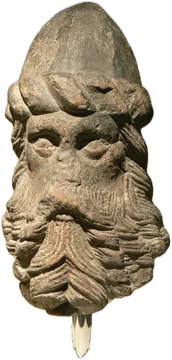
Killer · Sources
Even as he thus spake the end of death enfolded him; and his soul fleeting from his limbs was gone to Hades, bewailing her fate, leaving manliness and youth. And to him even in his death spake glorious Hector: Patroclus, wherefore dost thou prophesy for me sheer destruction?
and the iron din went up through the unresting air to the brazen heaven. But the horses of the son of Aeacus being apart from the battle were weeping, since first they learned that their charioteer had fallen in the dust beneath the hands of man-slaying Hector. In sooth Automedon, valiant son of Diores,
Il. 16.855 · Il. 17.428
Literary link · Sources
Even as he thus spake the end of death enfolded him; and his soul fleeting from his limbs was gone to Hades, bewailing her fate, leaving manliness and youth. And to him even in his death spake glorious Hector: Patroclus, wherefore dost thou prophesy for me sheer destruction?
Il. 16.859
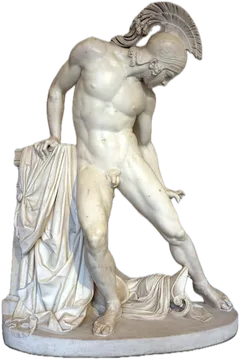
Friend · Sources
and led forth from the hut the fair-cheeked Briseis, and gave her to them to lead away. So the two went back beside the ships of the Achaeans, and with them, all unwilling, went the woman. But Achilles burst into tears, and withdrew apart from his comrades, and sat down on the shore of the grey sea, looking forth over the wine-dark deep.
and made them sit on couches and rugs of purple; and forthwith he spake to Patroclus, that was near: Set forth a larger bowl, thou son of Menoetius; mingle stronger drink, and prepare each man a cup, for these be men most dear, that are beneath my roof. So he spake, and Patroclus gave ear to his dear comrade. He cast down a great fleshing-block in the light of the fire and laid thereon a sheep's back and a fat goat's, and the chine of a great hog withal, rich with fat. And Automedon held them for him, while goodly Achilles carved.
Then the valiant son of Menoetius spake the first: Wherefore dost thou call me, Achilles? What need hast thou of me? And in answer to him spake Achilles, swift of foot: Goodly son of Menoetius, dear to this heart of mine, now methinks will the Achaeans be standing about my knees in prayer,
Il. 1.345 · Il. 9.205 · Il. 11.608 · Il. 11.616 · Il. 15.64 · Il. 17.271 · Il. 17.411 · Il. 17.557 · Il. 17.640–642 · Il. 18.81 · Il. 18.98–102 · Il. 18.152 · Il. 18.235–237 · Il. 18.317 · Il. 19.315 · Il. 23.18 · Il. 23.45 · Il. 23.99 · Il. 23.105 · Il. 24.4 · Il. 24.52 · Il. 24.591
Connection · Sources
At sight of him the old man sprang from his bright chair, and took him by the hand and led him in, and bade him be seated. But Patroclus from over against him refused, and spake, saying: I may not sit, old sir, fostered of Zeus, nor wilt thou persuade me. Revered and to be dreaded is he who sent me forth to learn
Il. 11.649
Teacher · Sources
with warm water, and sprinkle thereon kindly simples of healing power, whereof men say that thou hast learned from Achilles, whom Cheiron taught, the most righteous of the Centaurs. For the leeches, Podaleirius and Machaon, the one methinks lieth wounded amid the huts,
Il. 11.831–832
Ally · Sources
round about the valiant squire of the swift-footed son of Aeacus. And among them all stood warlike Achilles, urging on both horses and men that bear the shield. Fifty were the swift ships which Achilles, dear to Zeus, led to Troy,
Il. 16.165
Membership · Sources
But why doth my heart thus hold converse with me? There lieth by the ships a dead man unwept, unburied, even Patroclus; him will I not forget so long as I abide among the living, and my knees are quick. Nay, if even in the house of Hades men forget their dead,
Il. 22.389
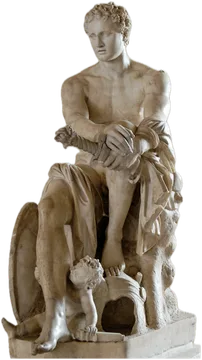
Poetic resemblance · Sources
for Achilles was standing by the stern of his ship, huge of hull, gazing upon the utter toil of battle and the tearful rout. And forthwith he spake to his comrade Patroclus, calling to him from beside the ship; and he heard, and came forth from the hut like unto Ares; and this to him was the beginning of evil.
then verily beyond their portion the Achaeans proved the better. Forth from out the range of darts they drew the warrior Cebriones from the battle-din of the Trojans, and stripped the armour from his shoulders; and Patroclus with fell intent leapt upon the Trojans. Thrice then leapt he upon them, the peer of swift Ares,
Il. 11.604 · Il. 16.784
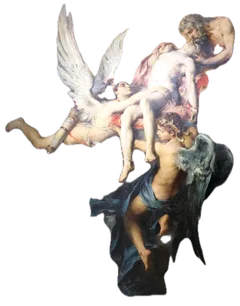
Struck down by Patroclus · Sources
even so beneath Patroclus did the leader of the Lycian shieldmen struggle in death; and he called by name his dear comrade: Dear Glaucus, warrior amid men of war, now in good sooth it behoveth thee to quit thee as a spearman and a dauntless warrior; now be evil war thy heart's desire if indeed thou art swift to fight.
Il. 16.490
Connection · Sources
the battlegear of Sarpedon, that Patroclus stripped from him; and he stood up, and spake among the Argives, saying: To win these prizes invite we warriors twain, the best there are, to clothe them in their armour and take bronze that cleaveth the flesh, and so make trial each of the other before the host.
Il. 23.800
Killed by Patroclus · Sources
В 16.737–743 Патрокл попадает камнем в лоб Кебриону, вознице Гектора, и тот с колесницы свалился, дух его кости оставил.
while with the other he grasped a stone, shining and jagged, that his hand compassed about. Firmly he planted himself, and hurled it, neither had he long awe of his foe, nor sped he his missile in vain, but smote the charioteer of Hector, even Cebriones, a bastard son of glorious Priam, upon the forehead with the sharp stone, as he was holding the reins of the horses.And both his brows did the stone dash together, and the bone held not, but the eyes fell to the ground in the dust even there, before his feet. And like a diver he fell from the well-wrought car, and his spirit left his bones. Then with mocking words didst thou speak to him, knight Patroclus:
Il. 16.737–743
Patron · Sources
В 17.6–7 Менелай с пикой и щитом ходит вокруг тела Патрокла, защищая его; отношение защиты прямо названо.
her first-born, ere then knowing naught of motherhood; even so over Patroclus strode fair-haired Menelaus, and before him he held his spear and his shield that was well-balanced upon every side, eager to slay the man who should come to seize the corpse. Then was Panthous' son, of the good spear of ash, not unheedful
Il. 17.6–7
See all 36
In art

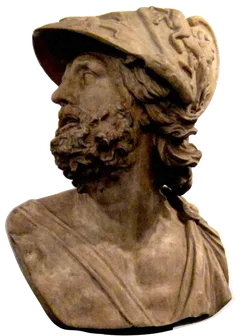
William Henry Fox Talbot. Bust of Patroclus. Metropolitan Museum of Art. CC0. https://www.wikidata.org/wiki/Q104213121
William Henry Fox Talbot. Bust of Patroclus. Metropolitan Museum of Art. CC0. https://www.wikidata.org/wiki/Q104213121

Jean-Auguste-Dominique Ingres. The Ambassadors of Agamemnon in the tent of Achilles. Beaux-Arts de Paris. Public domain. https://www.wikidata.org/wiki/Q16020875
Photograph / reproduction: Jean-Auguste-Dominique Ingres
Photograph / reproduction date: 1801
Jean-Auguste-Dominique Ingres. The Ambassadors of Agamemnon in the tent of Achilles. Beaux-Arts de Paris. Public domain. https://www.wikidata.org/wiki/Q16020875
Photograph / reproduction: Jean-Auguste-Dominique Ingres
Photograph / reproduction date: 1801

Nikolai Ge. Ахиллес оплакивает Патрокла. Belarusian National Arts Museum. Public domain. https://www.wikidata.org/wiki/Q17117194
Photograph / reproduction: Nikolai Ge
Photograph / reproduction date: 1855
Nikolai Ge. Ахиллес оплакивает Патрокла. Belarusian National Arts Museum. Public domain. https://www.wikidata.org/wiki/Q17117194
Photograph / reproduction: Nikolai Ge
Photograph / reproduction date: 1855

Jean-Auguste-Dominique Ingres. Achilles Receiving in his Tent the Envoys of Agamemnon. Nationalmuseum. Public domain. https://www.wikidata.org/wiki/Q18599184
Jean-Auguste-Dominique Ingres. Achilles Receiving in his Tent the Envoys of Agamemnon. Nationalmuseum. Public domain. https://www.wikidata.org/wiki/Q18599184

Dirck van Baburen. Achilles preparing to avenge the death of Patroclus. Hessen Kassel Heritage. Public domain. https://www.wikidata.org/wiki/Q3327366
Dirck van Baburen. Achilles preparing to avenge the death of Patroclus. Hessen Kassel Heritage. Public domain. https://www.wikidata.org/wiki/Q3327366

Jean Alaux. Briseis mourning the body of Patroclus in the tent of Achilles. Beaux-Arts de Paris. CC BY-SA 3.0. https://www.wikidata.org/wiki/Q62618838
Jean Alaux. Briseis mourning the body of Patroclus in the tent of Achilles. Beaux-Arts de Paris. CC BY-SA 3.0. https://www.wikidata.org/wiki/Q62618838

Pierre Edme Louis Pellier. Patroclus handing Briseis to the Heralds of Agamemnon. Public domain. https://www.wikidata.org/wiki/Q120556090
Pierre Edme Louis Pellier. Patroclus handing Briseis to the Heralds of Agamemnon. Public domain. https://www.wikidata.org/wiki/Q120556090
See all 16
Sources and verification
The character is matched to the catalogue.
- Wikipedia · Patroclus · CC BY-SA 4.0
Excerpt; remaining sentences omitted.
Reference material remains distinct from the poem’s assertions. Characters who share a name retain separate pages.