Peleus
Mortal man
In Greek mythology, Peleus (; Ancient Greek: Πηλεύς, romanized: Pēleús) was a hero, king of Phthia, husband of Thetis and the father of their son Achilles. This myth was already known to the hearers of Homer in the late 8th century BC.
Explore on the graph- Mentions
- 92
- Connected characters
- 8
- Books
- 18


Mentions in the Iliad
A. T. Murray, Loeb Classical Library, Harvard University Press, 1924 · Homer, Iliad with an English Translation · CC BY-SA 3.0 US
“The wrath sing, goddess, of Peleus' son, Achilles, that destructive wrath which brought countless woes upon the Achaeans, and sent forth to Hades many valiant souls of heroes, and made them themselves spoil for dogs and every bird; thus the plan of Zeus came to fulfillment,”
“Do not thus, mighty though you are, godlike Achilles, seek to deceive me with your wit; for you will not get by me nor persuade me. Are you willing, so that your yourself may keep your prize, for me to sit here idly in want, while you order me to give her back? No, if the great-hearted Achaeans give me a prize,”
“the word of Athene. She returned to Olympus to the palace of aegis-bearing Zeus, to join the company of the other gods. But the son of Peleus again addressed with violent words the son of Atreus, and in no way ceased from his wrath: Heavy with wine, with the face of a dog but the heart of a deer,”
“but let her be, as the sons of the Achaeans first gave her to him as a prize; nor do you, son of Peleus, be minded to strive with a king, might against might, for it is no common honour that is the portion of a sceptre-holding king, to whom Zeus gives glory. If you are a stronger fighter, and a goddess mother bore you,”
“who were his heralds and ready squires: Go to the hut of Achilles, Peleus' son, and take by the hand the fair-cheeked Briseis, and lead her hither; and if he give her not, I will myself go with a larger company and take her; that will be even the worse for him.”
“For often I have heard you glorying in the halls of my father, and declaring that you alone among the immortals warded off shameful ruin from the son of Cronos, lord of the dark clouds, on the day when the other Olympians wished to put him in bonds, even Hera and Poseidon and Pallas Athene.”
“But the son of Cronos, even Zeus that beareth the aegis, hath brought sorrows upon me, in that he casteth me into the midst of fruitless strifes and wranglings. For verily I and Achilles fought about a girl with violent words, and it was I that waxed wroth the first; but if e'er we shall be at one in counsel,”
See all 92
Connections
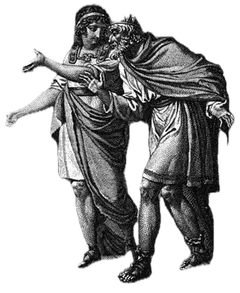
Father · Sources
to strive with the children of the mighty son of Cronos, albeit for one begotten of a River. Thou verily declarest that thy birth is from the wide-flowing River, whereas I avow me to be of the lineage of great Zeus. The father that begat me is one that is lord among the many Myrmidons, even Peleus, son of Aeacus; and Aeacus was begotten of Zeus.
Il. 21.188
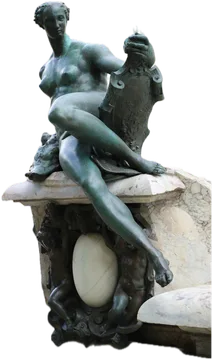
Wife · Sources
that hath endured so many grievous woes in her heart as are the sorrows that Zeus, son of Cronos, hath given me beyond all others? Of all the daughters of the sea he subdued me alone to a mortal, even to Peleus, son of Aeacus, and I endured the bed of a mortal albeit sore against my will. And lo, he lieth
fostered and reared, and gave to a warrior to be his wife, even to Peleus, who was heartily dear to the immortals. And all of you, O ye gods, came to her marriage, and among them thyself too didst sit at the feast, thy lyre in thy hand, O thou friend of evil-doers, faithless ever. Then Zeus, the cloud-gatherer, answered her, and said:
from his birth; for he excelled all men in good estate and in wealth, and was king over the Myrmidons, and to him that was but a mortal the gods gave a goddess to be his wife.
Il. 18.433 · Il. 24.60 · Il. 24.537
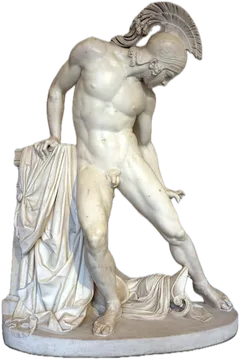
Son · Sources
The wrath sing, goddess, of Peleus' son, Achilles, that destructive wrath which brought countless woes upon the Achaeans, and sent forth to Hades many valiant souls of heroes, and made them themselves spoil for dogs and every bird; thus the plan of Zeus came to fulfillment,
Do not thus, mighty though you are, godlike Achilles, seek to deceive me with your wit; for you will not get by me nor persuade me. Are you willing, so that your yourself may keep your prize, for me to sit here idly in want, while you order me to give her back? No, if the great-hearted Achaeans give me a prize,
the word of Athene. She returned to Olympus to the palace of aegis-bearing Zeus, to join the company of the other gods. But the son of Peleus again addressed with violent words the son of Atreus, and in no way ceased from his wrath: Heavy with wine, with the face of a dog but the heart of a deer,
Il. 1.1 · Il. 1.130 · Il. 1.223 · Il. 1.277 · Il. 1.322 · Il. 1.396 · Il. 2.377 · Il. 2.770 · Il. 8.225 · Il. 8.372 · Il. 8.474 · Il. 9.106 · Il. 9.166 · Il. 9.206 · Il. 9.252 · Il. 9.394–400 · Il. 9.434 · Il. 9.690 · Il. 9.698 · Il. 10.393 · Il. 11.783 · Il. 13.113 · Il. 15.64 · Il. 15.74 · Il. 16.15 · Il. 16.33 · Il. 16.134 · Il. 16.168 · Il. 16.269 · Il. 16.653 · Il. 17.104 · Il. 17.196 · Il. 17.504 · Il. 17.557 · Il. 18.18 · Il. 18.22 · Il. 18.166 · Il. 18.267 · Il. 18.354 · Il. 19.83 · Il. 19.154 · Il. 19.215 · Il. 19.334 · Il. 19.348 · Il. 20.88 · Il. 20.160 · Il. 20.200 · Il. 20.288 · Il. 20.320 · Il. 20.364 · Il. 20.431 · Il. 21.153 · Il. 21.188 · Il. 21.205 · Il. 21.285 · Il. 21.520 · Il. 22.7 · Il. 22.58 · Il. 22.92 · Il. 22.113 · Il. 22.214 · Il. 22.229 · Il. 22.277 · Il. 22.420–421 · Il. 22.455 · Il. 23.277 · Il. 23.353 · Il. 23.776 · Il. 23.792 · Il. 24.59 · Il. 24.151 · Il. 24.180 · Il. 24.406 · Il. 24.458 · Il. 24.486 · Il. 24.507 · Il. 24.540 · Il. 24.572
Daughter · Sources
Him did fair Polydora, daughter of Peleus, bear to tireless Spercheius, a woman couched with a god, but in name she bare him to Borus, son of Perieres, who openly wedded her, when he had given gifts of wooing past counting. And of the next company warlike Eudorus was captain,
Il. 16.175
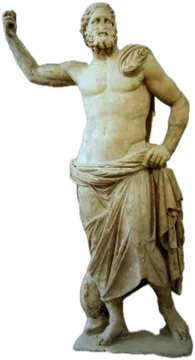
Connection · Sources
surely it were I that should win the first prize, and bear it to my hut; for ye know how far my horses twain surpass in excellence, seeing they are immortal, and it was Poseidon that gave them to my father Peleus, and he gave them to me. Howbeit I verily will abide, I and my single-hooved horses,
Il. 23.278
Connection · Sources
Ахиллес вспоминает обет Пелея: «Тщетно, Сперхей, обрекался, моляся тебе, мой родитель... волосы срезать мои и тебе принести с гекатомбой» (23.144–146). Обет прямо связывает Пелея и Сперхея.
Then again swift-footed goodly Achilles took other counsel; he took his stand apart from the fire and shore off a golden lock, the rich growth whereof he had nursed for the river Spercheüs, and his heart mightily moved, he spake, with a look over the wine-dark sea: Spercheüs, to no purpose did my father Peleus vow to theethat when I had come home thither to my dear native land, I would shear my hair to thee and offer a holy hecatomb, and on the selfsame spot would sacrifice fifty rams, males without blemish, into thy waters, where is thy demesne and thy fragrant altar. So vowed that old man, but thou didst not fulfill for him his desire.
Il. 23.143–146
Poetic kinship · Sources
unto king Peleus; and he received me with a ready heart, and cherished me as a father cherisheth his only son and well-beloved, that is heir to great possessions; and he made me rich and gave much people to me, and I dwelt on the furthermost border of Phthia, ruling over the Dolopians.
Il. 9.480–482
Friend · Sources
godlike Phoenix, his father's follower, that he might mark the running and tell the truth thereof. Then they all at one moment lifted the lash each above his yoke of horses, and smote them with the reins, and called to them with words, full eagerly and forthwith they sped swiftly over the plain
Il. 23.360
See all 8
In art

Hendrick van Balen the Elder. The wedding of Thetis and Peleus. Royal Museums of Fine Arts of Belgium. Public domain. https://www.wikidata.org/wiki/Q109499080
Hendrick van Balen the Elder. The wedding of Thetis and Peleus. Royal Museums of Fine Arts of Belgium. Public domain. https://www.wikidata.org/wiki/Q109499080

Peter Paul Rubens. The Wedding of Peleus and Thetis. Art Institute of Chicago. Public domain. https://www.wikidata.org/wiki/Q20261025
Photograph / reproduction: Peter Paul Rubens
Photograph / reproduction date: 1636
Peter Paul Rubens. The Wedding of Peleus and Thetis. Art Institute of Chicago. Public domain. https://www.wikidata.org/wiki/Q20261025
Photograph / reproduction: Peter Paul Rubens
Photograph / reproduction date: 1636

Jan Brueghel the Elder. The Feast of the Gods. The Wedding of Peleus and Thetis. Statens Museum for Kunst. Public domain. https://www.wikidata.org/wiki/Q20267349
Photograph / reproduction: Jan Brueghel the Elder / Hendrick van Balen the Elder
Photograph / reproduction date: between 1589 and 1632
Jan Brueghel the Elder. The Feast of the Gods. The Wedding of Peleus and Thetis. Statens Museum for Kunst. Public domain. https://www.wikidata.org/wiki/Q20267349
Photograph / reproduction: Jan Brueghel the Elder / Hendrick van Balen the Elder
Photograph / reproduction date: between 1589 and 1632

Hendrick van Balen the Elder. The Banquet of the Gods. The Wedding of Peleus and Thetis. Statens Museum for Kunst. Public domain. https://www.wikidata.org/wiki/Q20470136
Photograph / reproduction: Hendrick van Balen the Elder
Photograph / reproduction date: between 1590 and 1633
Hendrick van Balen the Elder. The Banquet of the Gods. The Wedding of Peleus and Thetis. Statens Museum for Kunst. Public domain. https://www.wikidata.org/wiki/Q20470136
Photograph / reproduction: Hendrick van Balen the Elder
Photograph / reproduction date: between 1590 and 1633

Hendrick van Balen the Elder. The Wedding of Thetis and Peleus. Fondation de France. Public domain. https://www.wikidata.org/wiki/Q29647780
Hendrick van Balen the Elder. The Wedding of Thetis and Peleus. Fondation de France. Public domain. https://www.wikidata.org/wiki/Q29647780

Robert Fagan. The Marriage of Peleus and Thetis. National Trust. Public domain. https://www.wikidata.org/wiki/Q52145589
Photograph / reproduction: Robert Fagan
Photograph / reproduction date: between 1793 and 1795
Robert Fagan. The Marriage of Peleus and Thetis. National Trust. Public domain. https://www.wikidata.org/wiki/Q52145589
Photograph / reproduction: Robert Fagan
Photograph / reproduction date: between 1793 and 1795

Unknown artist Unknown artist. Peleus and Thetis. Department of Greek, Etruscan, and Roman Antiquities of the Louvre. Public domain. https://www.wikidata.org/wiki/Q87763853
Photograph / reproduction: Unknown artistUnknown artist
Unknown artist Unknown artist. Peleus and Thetis. Department of Greek, Etruscan, and Roman Antiquities of the Louvre. Public domain. https://www.wikidata.org/wiki/Q87763853
Photograph / reproduction: Unknown artistUnknown artist
See all 10
Sources and verification
The character is matched to the catalogue.
- Wikipedia · Peleus · CC BY-SA 4.0
Excerpt; remaining sentences omitted.
Reference material remains distinct from the poem’s assertions. Characters who share a name retain separate pages.