Neleus
Mortal man
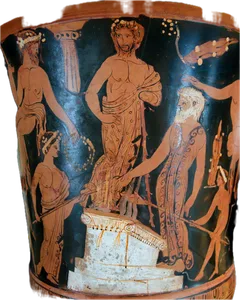
Neleus (; Ancient Greek: Νηλεύς) was a mythological king of Pylos. In some accounts, he was also counted as an Argonaut instead of his son, Nestor.
Explore on the graph- Mentions
- 18
- Connected characters
- 1
- Books
- 6


Mentions in the Iliad
A. T. Murray, Loeb Classical Library, Harvard University Press, 1924 · Homer, Iliad with an English Translation · CC BY-SA 3.0 US
“So he took his stand above his head, in the likeness of the son of Neleus, even Nestor, whom above all the elders Agamemnon held in honour; likening himself to him, the Dream from heaven spake, saying: Thou sleepest, son of wise-hearted Atreus, the tamer of horses. To sleep the whole night through beseemeth not a man that is a counsellor,”
“but Agamemnon bade the clear-voiced heralds summon to the place of gathering the long-haired Achaeans. And they made summons, and the men gathered full quickly. But the king first made the council of the great-souled elders to sit down beside the ship of Nestor, the king Pylos-born.”
“and took his stand before the horses of the old man, Neleus' son, and spake and addressed him with winged words: Old sir, of a surety young warriors press thee sore; whereas thy might is broken and grievous old age attends thee, and thy squire is a weakling and thy horses slow.”
“then many were the hairs that he pulled from his head by the very roots in appeal to Zeus that is above, and in his noble heart he groaned mightily. And this plan seemed to his mind the best, to go first of all to Nestor, son of Neleus, if so be he might contrive with him some goodly device”
“he that is not the dear son of goddess or of god. Deeds hath he wrought that methinks will be a sorrow to the Argives for ever and aye, so many evils hath he devised against the Achaeans. But go now, run swiftly along the lines of ships and call hither Aias and Idomeneus, and I will go to goodly Nestor”
“but rather let us ourselves be busy; even thus I ween hath Zeus laid upon us even at our birth the heaviness of woe. So spake he, and sent forth his brother when he had duly given him commandment. But he went his way after Nestor, shepherd of the host, and found him by his hut and his black ship”
See all 18
Connections
Son · Sources
Son · Sources
So he took his stand above his head, in the likeness of the son of Neleus, even Nestor, whom above all the elders Agamemnon held in honour; likening himself to him, the Dream from heaven spake, saying: Thou sleepest, son of wise-hearted Atreus, the tamer of horses. To sleep the whole night through beseemeth not a man that is a counsellor,
but Agamemnon bade the clear-voiced heralds summon to the place of gathering the long-haired Achaeans. And they made summons, and the men gathered full quickly. But the king first made the council of the great-souled elders to sit down beside the ship of Nestor, the king Pylos-born.
and took his stand before the horses of the old man, Neleus' son, and spake and addressed him with winged words: Old sir, of a surety young warriors press thee sore; whereas thy might is broken and grievous old age attends thee, and thy squire is a weakling and thy horses slow.
Il. 2.20 · Il. 2.53 · Il. 8.100 · Il. 10.18 · Il. 10.54 · Il. 10.73 · Il. 10.87 · Il. 10.163 · Il. 10.555 · Il. 11.511 · Il. 11.618 · Il. 11.683 · Il. 14.42 · Il. 23.302 · Il. 23.349 · Il. 23.617
See all 1
In art
See all 0
There is nothing in this section yet.
Sources and verification
The character is matched to the catalogue.
- Wikipedia · Neleus · CC BY-SA 4.0
Excerpt; remaining sentences omitted.
Reference material remains distinct from the poem’s assertions. Characters who share a name retain separate pages.