Meriones
Mortal man
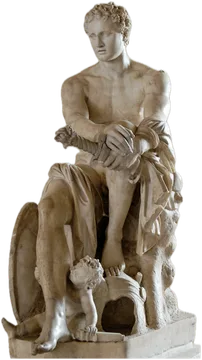
Meriones ( mə-RY-ə-neez; Ancient Greek: Μηριόνης, romanized: Mēriónēs) was the Cretan son of Molus and Melphis or Euippe in Greek mythology. Molus was a half-brother of Idomeneus.
Explore on the graph- Mentions
- 42
- Connected characters
- 5
- Books
- 14


Mentions in the Iliad
A. T. Murray, Loeb Classical Library, Harvard University Press, 1924 · Homer, Iliad with an English Translation · CC BY-SA 3.0 US
“Of all these was Idomeneus, famed for his spear, captain, and Meriones, the peer of Enyalius, slayer of men. And with these there followed eighty black ships. And Tlepolemus, son of Heracles, a valiant man and tall, led from Rhodes nine ships of the lordly Rhodians,”
“Thus ranged he giving his commands through the ranks of warriors; and he came to the Cretans as he fared through the throng of men. These were arming them for war around wise-hearted Idomeneus; and Idomeneus stood amid the foremost fighters like a wild boar in valour, while Meriones was speeding on the hindmost battalions.”
“but the son of Atreus, Menelaus famed for his spear, smote him as he fled before him with a thrust of his spear in the back between the shoulders, and drave it through his breast. So he fell face foremost, and upon him his armour clanged. And Meriones slew Phereclus, son of Tecton,”
“After him Meriones pursued, and when he had come up with him, smote him in the right buttock, and the spear-point passed clean through even to the bladder beneath the bone;, and he fell to his knees with a groan, and death enfolded him. And Pedaeus, Antenor's son, was slain of Meges;”
“and after them Idomeneus and Idomeneus' comrade Meriones, the peer of Enyalius, slayer of men, and after them Eurypylus, the glorious son of Euaemon; and upsprang Thoas, son of Andraemon, and goodly Odysseus; all these were minded to do battle with goodly Hector.”
“so he fell from out the car, and upon him his armour clanged. And after him came the sons of Atreus, Agamemnon and Menelaus, and after them the Aiantes, clothed in furious valour, and after them Idomeneus and Idomeneus' comrade, Meriones, peer of Enyalius, slayer of men,”
“Forth hasted the sentinels in their harness around Nestor's son Thrasymedes, shepherd of the host, and Ascalaphus and Ialmenus, sons of Ares, and Meriones and Aphareus and Deïpyrus, and the son of Creon, goodly Lycomedes.”
See all 41
Connections
Father · Sources
the kings of the Argives, even all that had been called to the council. But with them went Meriones and the glorious son of Nestor; for of themselves they bade these share in their counsel. So they went through and out from the digged ditch and sate them down in an open space, where the ground shewed clear of dead men fallen,
but he gave it to his own son Meriones to wear; and now, being set thereon, it covered the head of Odysseus. So when the twain had clothed them in their dread armour, they went their way and left there all the chieftains. And for them Pallas Athene sent forth on their right a heron, hard by the way,
Il. 10.196 · Il. 10.270
Poetic resemblance · Sources
and after them Idomeneus and Idomeneus' comrade Meriones, the peer of Enyalius, slayer of men, and after them Eurypylus, the glorious son of Euaemon; and upsprang Thoas, son of Andraemon, and goodly Odysseus; all these were minded to do battle with goodly Hector.
so he fell from out the car, and upon him his armour clanged. And after him came the sons of Atreus, Agamemnon and Menelaus, and after them the Aiantes, clothed in furious valour, and after them Idomeneus and Idomeneus' comrade, Meriones, peer of Enyalius, slayer of men,
So spake he, and Meriones, the peer of swift Ares, speedily took from the hut a spear of bronze, and followed Idomeneus with high thought of battle. And even as Ares, the bane of mortals, goeth forth to war, and with him followeth Rout, his son, valiant alike and fearless,
Il. 7.166 · Il. 8.264 · Il. 13.295 · Il. 13.328 · Il. 13.528 · Il. 17.259
Ally · Sources
and after them Idomeneus and Idomeneus' comrade Meriones, the peer of Enyalius, slayer of men, and after them Eurypylus, the glorious son of Euaemon; and upsprang Thoas, son of Andraemon, and goodly Odysseus; all these were minded to do battle with goodly Hector.
Il. 7.165–166
Friend · Sources
so he fell from out the car, and upon him his armour clanged. And after him came the sons of Atreus, Agamemnon and Menelaus, and after them the Aiantes, clothed in furious valour, and after them Idomeneus and Idomeneus' comrade, Meriones, peer of Enyalius, slayer of men,
and bid him arise, if so be he will be minded to go to the sacred company of the sentinels and give them charge. To him would they hearken as to no other, for his son is captain over the guard, he and Meriones, comrade of Idomeneus; for to them above all we entrusted this charge.
even so shone the bronze about his breast as he ran. And Meriones, his valiant squire, met him, while yet he was near the hut; for he was on his way to fetch him a spear of bronze; and mighty Idomeneus spake to him: Meriones, Molus' son, swift of foot, thou dearest of my comrades,
Il. 8.263–264 · Il. 10.58–59 · Il. 13.249 · Il. 23.113 · Il. 23.124 · Il. 23.528 · Il. 23.860 · Il. 23.888
Friend · Sources
howbeit he smote Coeranus the comrade and charioteer of Meriones that followed him from out of well-built Lyctus—for on foot had Idomeneus come at the first from the curved ships, and would have yielded great victory to the Trojans, had not Coeranus speedily driven up the swift-footed horses.
Il. 17.610
Killed by Meriones · Sources
Стих 5.59: «Сын Гармонида Тектона Ферекл умерщвлен Мерионом».
but the son of Atreus, Menelaus famed for his spear, smote him as he fled before him with a thrust of his spear in the back between the shoulders, and drave it through his breast. So he fell face foremost, and upon him his armour clanged. And Meriones slew Phereclus, son of Tecton,
Il. 5.59
See all 5
In art
See all 0
There is nothing in this section yet.
Sources and verification
The character is matched to the catalogue.
- Wikipedia · Meriones (mythology) · CC BY-SA 4.0
Excerpt; remaining sentences omitted.
Reference material remains distinct from the poem’s assertions. Characters who share a name retain separate pages.