Laomedon
Mortal man
In Greek mythology, Laomedon (; Ancient Greek: Λαομέδων, romanized: Lāomédōn, lit. 'ruler of the people' or 'lord of the people') was a Trojan king, son of Ilus and thus nephew of Ganymede and Assaracus. Laomedon was variously identified with different parents and siblings, as well as numerous children, including Priam and Tithonus.
Explore on the graph- Mentions
- 8
- Connected characters
- 9
- Books
- 7


Mentions in the Iliad
A. T. Murray, Loeb Classical Library, Harvard University Press, 1924 · Homer, Iliad with an English Translation · CC BY-SA 3.0 US
“Rise, thou son of Laomedon, the chieftains of the horse-taming Trojans, and of the brazen-coated Achaeans, summon thee to go down into the plain, that ye may swear oaths of faith with sacrifice. But Alexander and Menelaus, dear to Ares, will do battle with long spears for the woman's sake;”
“For they are of that stock wherefrom Zeus, whose voice is borne afar, gave to Tros recompense for his son Ganymedes, for that they were the best of all horses that are beneath the dawn and the sun. Of this stock the king of men Anchises stole a breed, putting his mares to them while Laomedon knew naught thereof.”
“who on a time came hither by reason of the mares of Laomedon with but six ships and a scantier host, yet sacked the city of Ilios and made waste her streets. But thine is a coward's heart, and thy people are minishing. In no wise methinks shall thy coming from Lycia prove a defence to the men of Troy,”
“Then Euryalus slew Dresus and Opheltius, and went on after Aesepus and Pedasus, whom on a time the fountain-nymph Abarbarea bare to peerless Bucolion. Now Bucolion was son of lordly Laomedon, his eldest born, though the mother that bare him was unwed;”
“but gave not glorious hecatombs to the gods? Of a surety shall the fame thereof reach as far as the dawn spreadeth, and men will forget the wall that I and Phoebus Apollo built with toil for the warrior Laomedon. Then greatly troubled, Zeus, the cloud-gatherer, spake to him:”
“Meanwhile upon him leapt Dolops, well skilled with the spear, the son of Lampus, whom Lampus, son of Laomedon, begat, even his bravest son, well skilled in furious might; he it was that then thrust with his spear full upon the shield of Phyleus' son, setting upon him from nigh at hand. But his cunningly-wrought corselet saved him,”
See all 8
Connections
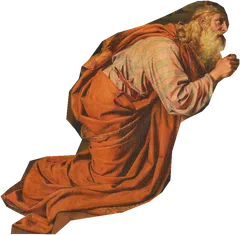
Son · Sources
Rise, thou son of Laomedon, the chieftains of the horse-taming Trojans, and of the brazen-coated Achaeans, summon thee to go down into the plain, that ye may swear oaths of faith with sacrifice. But Alexander and Menelaus, dear to Ares, will do battle with long spears for the woman's sake;
And Ilus again begat a son, peerless Laomedon, and Laomedon begat Tithonus and Priam and Clytius, and Hicetaon, scion of Ares. And Assaracus begat Capys, and he Anchises; but Anchises begat me and Priam goodly Hector.
Il. 3.250 · Il. 20.237
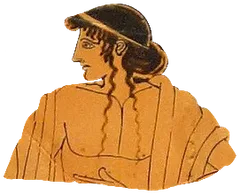
See all 9
In art

Laomedon Refusing Payment to Poseidon and Apollo. Hunterian Museum and Art Gallery. Public domain. https://www.wikidata.org/wiki/Q104872325
Laomedon Refusing Payment to Poseidon and Apollo. Hunterian Museum and Art Gallery. Public domain. https://www.wikidata.org/wiki/Q104872325
See all 1
Sources and verification
The character is matched to the catalogue.
- Wikipedia · Laomedon · CC BY-SA 4.0
Excerpt; remaining sentences omitted.
Reference material remains distinct from the poem’s assertions. Characters who share a name retain separate pages.