Ilus
Mortal man
In Greek mythology, Ilus (; Ancient Greek: Ἶλος, romanized: Îlos, lit. 'illustrious', 'bright' or 'the shining one') was the founder of the city called Ilios or Ilion (Latinized as Ilium) to which he gave his name. When the latter became the chief city of the Trojan people it was also often called Troy, the name by which it is best known today.
Explore on the graph- Mentions
- 4
- Connected characters
- 4
- Books
- 3


Mentions in the Iliad
A. T. Murray, Loeb Classical Library, Harvard University Press, 1924 · Homer, Iliad with an English Translation · CC BY-SA 3.0 US
“is holding council by the tomb of godlike Ilus, away from the turmoil; but as touching the guards whereof thou askest, O warrior, no special guard keepeth or watcheth the host. By all the watch-fires of the Trojans verily, they that needs must, lie awake and bid one another keep watch,”
“but the son of Atreus followed after, calling fiercely to the Danaans. And past the tomb of ancient Ilos, son of Dardanus, over the midst of the plain, past the wild fig-tree they sped, striving to win to the city, and ever did the son of Atreus follow shouting, and with gore were his invincible hands bespattered.”
“aimed an arrow at Tydeus' son, shepherd of the host, leaning the while against a pillar on the barrow that men's hands reared for Ilus, son of Dardanus, an elder of the people in days of old. Now Diomedes was stripping the gleaming corselet of valiant Agastrophus from about his breast, and the shield from off his shoulder,”
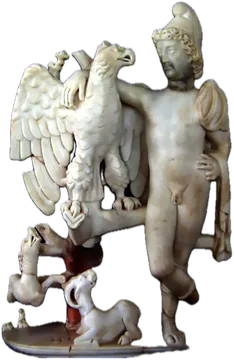
“And Erichthonius begat Tros to be king among the Trojans, and from Tros again three peerless sons were born, Ilus, and Assaracus, and godlike Ganymedes that was born the fairest of mortal men; wherefore the gods caught him up on high to be cupbearer to Zeus by reason of his beauty, that he might dwell with the immortals.”
See all 4
Connections
Father · Sources
And Erichthonius begat Tros to be king among the Trojans, and from Tros again three peerless sons were born, Ilus, and Assaracus, and godlike Ganymedes that was born the fairest of mortal men; wherefore the gods caught him up on high to be cupbearer to Zeus by reason of his beauty, that he might dwell with the immortals.
Il. 20.231–232
Brother through father · Sources
Братство или сестринство выведено из общего родителя: Трос. Матери и отцы, не указанные в источнике, не предполагаются. Квалификация братства/сестринства: Илиада: Общий отец подтверждён; сведения о матерях неполны. Различие матерей не установлено. Общие родители: Трос (отец Ганимеда).
Гомер, Илиада — роль родителя · Ил. 20.230–232And Erichthonius begat Tros to be king among the Trojans, and from Tros again three peerless sons were born, Ilus, and Assaracus, and godlike Ganymedes that was born the fairest of mortal men; wherefore the gods caught him up on high to be cupbearer to Zeus by reason of his beauty, that he might dwell with the immortals.
Il. 20.231–232
Brother through father · Sources
Братство или сестринство выведено из общего родителя: Трос. Матери и отцы, не указанные в источнике, не предполагаются. Квалификация братства/сестринства: Илиада: Общий отец подтверждён; сведения о матерях неполны. Различие матерей не установлено. Общие родители: Трос (отец Ганимеда).
Гомер, Илиада — роль родителя · Ил. 20.230–232For they are of that stock wherefrom Zeus, whose voice is borne afar, gave to Tros recompense for his son Ganymedes, for that they were the best of all horses that are beneath the dawn and the sun. Of this stock the king of men Anchises stole a breed, putting his mares to them while Laomedon knew naught thereof.
And Erichthonius begat Tros to be king among the Trojans, and from Tros again three peerless sons were born, Ilus, and Assaracus, and godlike Ganymedes that was born the fairest of mortal men; wherefore the gods caught him up on high to be cupbearer to Zeus by reason of his beauty, that he might dwell with the immortals.
Il. 5.266 · Il. 20.231–232
See all 4
In art
See all 0
There is nothing in this section yet.
Sources and verification
The character is matched to the catalogue.
- Wikipedia · Ilus (son of Tros) · CC BY-SA 4.0
Excerpt; remaining sentences omitted.
Reference material remains distinct from the poem’s assertions. Characters who share a name retain separate pages.