Cleitus
Mortal man
A character named in Homer's Iliad. The English introduction is not yet available.
Explore on the graph- Mentions
- 1
- Connected characters
- 3
- Books
- 1


Mentions in the Iliad
A. T. Murray, Loeb Classical Library, Harvard University Press, 1924 · Homer, Iliad with an English Translation · CC BY-SA 3.0 US
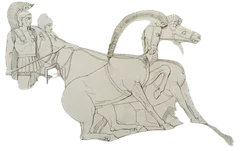
“And he smote Cleitus, the glorious son of Peisenor, comrade of Polydamas, the lordly son of Panthous, even as he was holding the reins in his hand, and was busied with his horses; for thither was he driving them, where the most battalions were being driven in rout, thus doing pleasure unto Hector and the Trojans. But full swiftly”
See all 1
Connections
Father · Sources
Father · Sources
And he smote Cleitus, the glorious son of Peisenor, comrade of Polydamas, the lordly son of Panthous, even as he was holding the reins in his hand, and was busied with his horses; for thither was he driving them, where the most battalions were being driven in rout, thus doing pleasure unto Hector and the Trojans. But full swiftly
Il. 15.445
Killer · Sources
Killer · Sources
Тевкр стреляет по троянцам, и Клит «был им поражен» (15.445): убийство прямо названо.
Him hath great-souled Hector slain. Where now are thy arrows that bring swift death, and the bow that Phoebus Apollos gave thee? So spake he, and the other hearkened, and ran, and took his stand close beside him, bearing in his hand his bent-back bow and the quiver that held his arrows; and full swiftly did he let fly his shafts upon the Trojans.And he smote Cleitus, the glorious son of Peisenor, comrade of Polydamas, the lordly son of Panthous, even as he was holding the reins in his hand, and was busied with his horses; for thither was he driving them, where the most battalions were being driven in rout, thus doing pleasure unto Hector and the Trojans. But full swiftly
Il. 15.442–445
Friend · Sources
Friend · Sources
Описание называет Клита товарищем Пулидаманта; стих 15.446 прямо называет его «Пулидаманта товарищ».
And he smote Cleitus, the glorious son of Peisenor, comrade of Polydamas, the lordly son of Panthous, even as he was holding the reins in his hand, and was busied with his horses; for thither was he driving them, where the most battalions were being driven in rout, thus doing pleasure unto Hector and the Trojans. But full swiftly
Il. 15.445–446
See all 3
In art
See all 0
There is nothing in this section yet.
Sources and verification
The character is matched to the catalogue.
Reference material remains distinct from the poem’s assertions. Characters who share a name retain separate pages.