Atreus
Mortal man
In Greek mythology, Atreus (Ancient Greek: Ἀτρεύς, [a.trěu̯s] lit. 'fearless') was a king of Mycenae in the Peloponnese, the son of Pelops and Hippodamia, and the father of Agamemnon and Menelaus. His descendants became known collectively as the Atreidae (Ancient Greek: Ἀτρείδαι Atreidai).
Explore on the graph- Mentions
- 83
- Connected characters
- 4
- Books
- 16


Mentions in the Iliad
A. T. Murray, Loeb Classical Library, Harvard University Press, 1924 · Homer, Iliad with an English Translation · CC BY-SA 3.0 US
“from the time when first they parted in strife Atreus' son, king of men, and brilliant Achilles. Who then of the gods was it that brought these two together to contend? The son of Leto and Zeus; for he in anger against the king roused throughout the host an evil pestilence, and the people began to perish,”
“When he had thus spoken he sat down, and among them arose the warrior, son of Atreus, wide-ruling Agamemnon, deeply troubled. With rage his black heart was wholly filled, and his eyes were like blazing fire. To Calchas first of all he spoke, and his look threatened evil:”
“In answer to him spoke swift-footed brilliant Achilles: Most glorious son of Atreus, most covetous of all, how shall the great-hearted Achaeans give you a prize? We know nothing of a hoard of wealth in common store, but whatever we took by pillage from the cities has been apportioned,”
“and break up the assembly, and slay the son of Atreus, or stay his anger and curb his spirit. While he pondered this in mind and heart, and was drawing from its sheath his great sword, Athene came from heaven. The white-armed goddess Hera had sent her forth,”
“yet he is the mightier, since he is king over more. Son of Atreus, check your rage. Indeed, I beg you to let go your anger against Achilles, who is for all the Achaeans a mighty bulwark in evil war. In answer to him spoke lord Agamemnon:”
“The son of Peleus went his way to his huts and his balanced ships together with the son of Menoetius, and with his men; but the son of Atreus launched a swift ship on the sea, and chose for it twenty rowers, and drove on board a hecatomb for the god, and brought the fair-cheeked daughter of Chryses and set her in the ship;”
“has dishonoured me: for he has taken and keeps my prize through his own arrogant act. So he spoke, weeping, and his lady mother heard him, as she sat in the depths of the sea beside the old man, her father. And speedily she came forth from the grey sea like a mist, and sat down before him, as he wept,”
See all 83
Connections
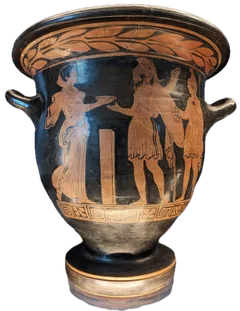
Father · Sources
Описание прямо называет Атрея сыном Пелопса; стихи 2.104–105 передают скипетр от Пелопса Атрею, подчёркивая родство.
ceasing from their clamour. Then among them lord Agamemnon uprose, bearing in his hands the sceptre which Hephaestus had wrought with toil. Hephaestus gave it to king Zeus, son of Cronos, and Zeus gave it to the messenger Argeïphontes; and Hermes, the lord, gave it to Pelops, driver of horses,and Pelops in turn gave it to Atreus, shepherd of the host; and Atreus at his death left it to Thyestes, rich in flocks, and Thyestes again left it to Agamemnon to bear, that so he might be lord of many isles and of all Argos. Thereon he leaned, and spake his word among the Argives:
Il. 2.104–105
Connection · Sources
Стих 2.105 прямо говорит, что Пелопс дал скипетр Атрею; устойчивое отношение передачи, тип other.
ceasing from their clamour. Then among them lord Agamemnon uprose, bearing in his hands the sceptre which Hephaestus had wrought with toil. Hephaestus gave it to king Zeus, son of Cronos, and Zeus gave it to the messenger Argeïphontes; and Hermes, the lord, gave it to Pelops, driver of horses,and Pelops in turn gave it to Atreus, shepherd of the host; and Atreus at his death left it to Thyestes, rich in flocks, and Thyestes again left it to Agamemnon to bear, that so he might be lord of many isles and of all Argos. Thereon he leaned, and spake his word among the Argives:
Il. 2.104–105
Brother · Sources
Илиада 2.105–107 даёт преемство скипетра Пелопс→Атрей→Фиест; братство прямо названо в сохранённом снимке английской Википедии. Квалификация братства/сестринства: Илиада: Общий родитель подтверждён; роль отца или матери не установлена. Общие родители: Пелопс.
and Pelops in turn gave it to Atreus, shepherd of the host; and Atreus at his death left it to Thyestes, rich in flocks, and Thyestes again left it to Agamemnon to bear, that so he might be lord of many isles and of all Argos. Thereon he leaned, and spake his word among the Argives:
Il. 2.105–107
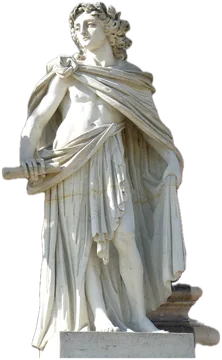
Son · Sources
from the time when first they parted in strife Atreus' son, king of men, and brilliant Achilles. Who then of the gods was it that brought these two together to contend? The son of Leto and Zeus; for he in anger against the king roused throughout the host an evil pestilence, and the people began to perish,
When he had thus spoken he sat down, and among them arose the warrior, son of Atreus, wide-ruling Agamemnon, deeply troubled. With rage his black heart was wholly filled, and his eyes were like blazing fire. To Calchas first of all he spoke, and his look threatened evil:
In answer to him spoke swift-footed brilliant Achilles: Most glorious son of Atreus, most covetous of all, how shall the great-hearted Achaeans give you a prize? We know nothing of a hoard of wealth in common store, but whatever we took by pillage from the cities has been apportioned,
Il. 1.7 · Il. 1.102 · Il. 1.122 · Il. 1.191 · Il. 1.282 · Il. 1.308 · Il. 1.355 · Il. 1.387 · Il. 2.6 · Il. 2.23 · Il. 2.54 · Il. 2.85 · Il. 2.185 · Il. 2.249 · Il. 2.434 · Il. 2.477 · Il. 2.578 · Il. 2.772 · Il. 3.120 · Il. 3.178 · Il. 4.223 · Il. 4.255 · Il. 4.311 · Il. 4.326 · Il. 4.356 · Il. 4.403 · Il. 5.528 · Il. 5.552 · Il. 7.176 · Il. 7.312 · Il. 7.470 · Il. 8.227 · Il. 8.261 · Il. 8.292 · Il. 9.69 · Il. 9.96 · Il. 9.163 · Il. 9.226 · Il. 9.300 · Il. 9.315 · Il. 9.331 · Il. 9.368 · Il. 9.388 · Il. 9.672–676 · Il. 9.697 · Il. 10.3 · Il. 10.81 · Il. 10.88 · Il. 10.102–103 · Il. 10.128 · Il. 11.94 · Il. 11.233 · Il. 11.766 · Il. 13.112 · Il. 14.22 · Il. 14.137 · Il. 19.35 · Il. 19.146 · Il. 19.241 · Il. 23.36 · Il. 23.156 · Il. 23.233 · Il. 23.486 · Il. 23.890 · Il. 24.654
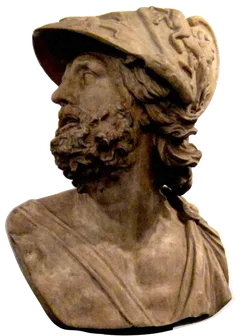
Son · Sources
and he withdraweth back again and pallor layeth hold of his cheeks; even so did godlike Alexander, seized with fear of Atreus' son, shrink back into the throng of the lordly Trojans. But Hector saw him, and chid him with words of shame: Evil Paris, most fair to look upon, thou that art mad after women, thou beguiler,
when they stood Menelaus overtopped him with his broad shoulders; howbeit when the twain were seated Odysseus was the more royal. But when they began to weave the web of speech and of counsel in the presence of all, Menelaus in truth spake fluently, with few words, but very clearly, seeing he was not a man of lengthy speech
brandishing their spears in wrath one at the other. First Alexander hurled his far-shadowing spear, and smote upon the son of Atreus' shield that was well balanced on every side ; howbeit the bronze brake not through but its point was turned in the stout shield. Next Atreus' son, Menelaus, rushed upon him with his spear,
Il. 3.37 · Il. 3.213 · Il. 3.347 · Il. 3.361 · Il. 3.449 · Il. 4.205 · Il. 5.50 · Il. 5.207 · Il. 5.552 · Il. 5.570 · Il. 5.578 · Il. 7.470 · Il. 8.261 · Il. 13.581 · Il. 17.69 · Il. 17.553 · Il. 23.355 · Il. 23.594
See all 4
In art
See all 0
There is nothing in this section yet.
Sources and verification
The character is matched to the catalogue.
- Wikipedia · Atreus · CC BY-SA 4.0
Excerpt; remaining sentences omitted.
Reference material remains distinct from the poem’s assertions. Characters who share a name retain separate pages.